
Why UK Founders Are Moving Their Business to Cyprus in 2026
You're billing £8,000 a month. After UK income tax, National Insurance, and dividend tax, you're keeping less than half of it.
That's not a worst-case scenario. That's the default outcome for most UK-based solopreneurs and freelancers once they start earning real money. The UK tax system was not designed with you in mind. It was designed around employees, payroll, and PAYE. If you're running your own business, every layer of tax compounds.
The good news is that this is a structural problem, and structural problems have structural solutions.
What UK Founders Are Actually Paying
Let's make this concrete. A UK founder earning £100,000 in profit through their limited company faces a layered tax stack that most people only fully understand when they see their accountant's year-end summary.
At the corporate level, the UK's main corporation tax rate is 25% on profits above £250,000 (19% on profits up to £50,000, with marginal relief in between). Once you extract that money as a dividend, you'll face an additional 33.75% dividend tax at the higher rate, or 39.35% at the additional rate for income above £125,140. Then there's the effective loss of your personal allowance above £100,000, creating a marginal rate that hits 60% in the £100,000–£125,140 band.
Add employer and employee National Insurance on any salary you pay yourself, and the picture gets worse.
For a founder pulling out £100,000 in profit, after corporation tax and dividend tax, take-home can be closer to £52,000–£58,000, depending on how the income is structured. You're working to hand over roughly 40–48p of every pound you earn.
Why Cyprus Changes the Maths
Cyprus is not a tax haven. It is an EU member state with a legal, government-designed tax framework that happens to be extraordinarily well-suited to founders who live and work flexibly.
Three specific regimes do the heavy lifting.
The Non-Dom regime (Non-Domicile status) is the one most founders raise first, and for good reason. Under the Non-Dom regime, eligible individuals pay 0% tax on dividends received from their company, for up to 17 years. That's not a special deal negotiated behind closed doors. It's a published, statutory regime designed to attract talent and capital to Cyprus. To qualify, you generally need to spend at least 60 days per year in Cyprus, not be domiciled in Cyprus, and not spend more than 183 days per year in any other single country.
The 60-day rule is one of the more flexible residency thresholds in Europe. You don't need to move your entire life to Cyprus. A genuine, documented presence is what counts.
The 50% income tax exemption applies to individuals earning a remuneration of €55,000 or more per year from employment in Cyprus. Eligible founders who pay themselves a salary through their Cyprus company can reduce their taxable employment income by 50% for the first ten years of Cyprus tax residency. On a salary of €80,000, that means tax is calculated on €40,000, roughly halving the income tax bill.
The IP Box regime is worth knowing about, particularly for product builders, SaaS founders, and digital creators. It applies a 2.5% effective corporate tax rate to profits derived from qualifying intellectual property, including patents, software, trademarks, and copyrights. The qualification criteria are specific, and not every business will meet them in full, so it is best explored with a local tax advisor rather than assumed.
"Sounds Too Good to Be True": The Objection Worth Addressing
This is the most common reaction, and it's fair. But these are not loopholes. They are legislated incentives, published in Cyprus tax law, approved under EU state aid rules, and actively promoted by the Cyprus government to attract high-value individuals and businesses. They are used by thousands of founders and professionals across Europe.
The distinction matters: a loophole is a gap that might be closed tomorrow. The Non-Dom regime has been in place for years, has survived EU scrutiny, and is an intentional policy choice by Cyprus to compete for mobile talent.
The more relevant question is not "is this legal?" It is "am I structuring this correctly for my specific situation?" That's where professional advice becomes essential.
Comparing the Two Structures
Put two founders side by side. Both earn £100,000 in profit from their online business. One is structured through a UK limited company; one has set up a Cyprus company under the Non-Dom regime.
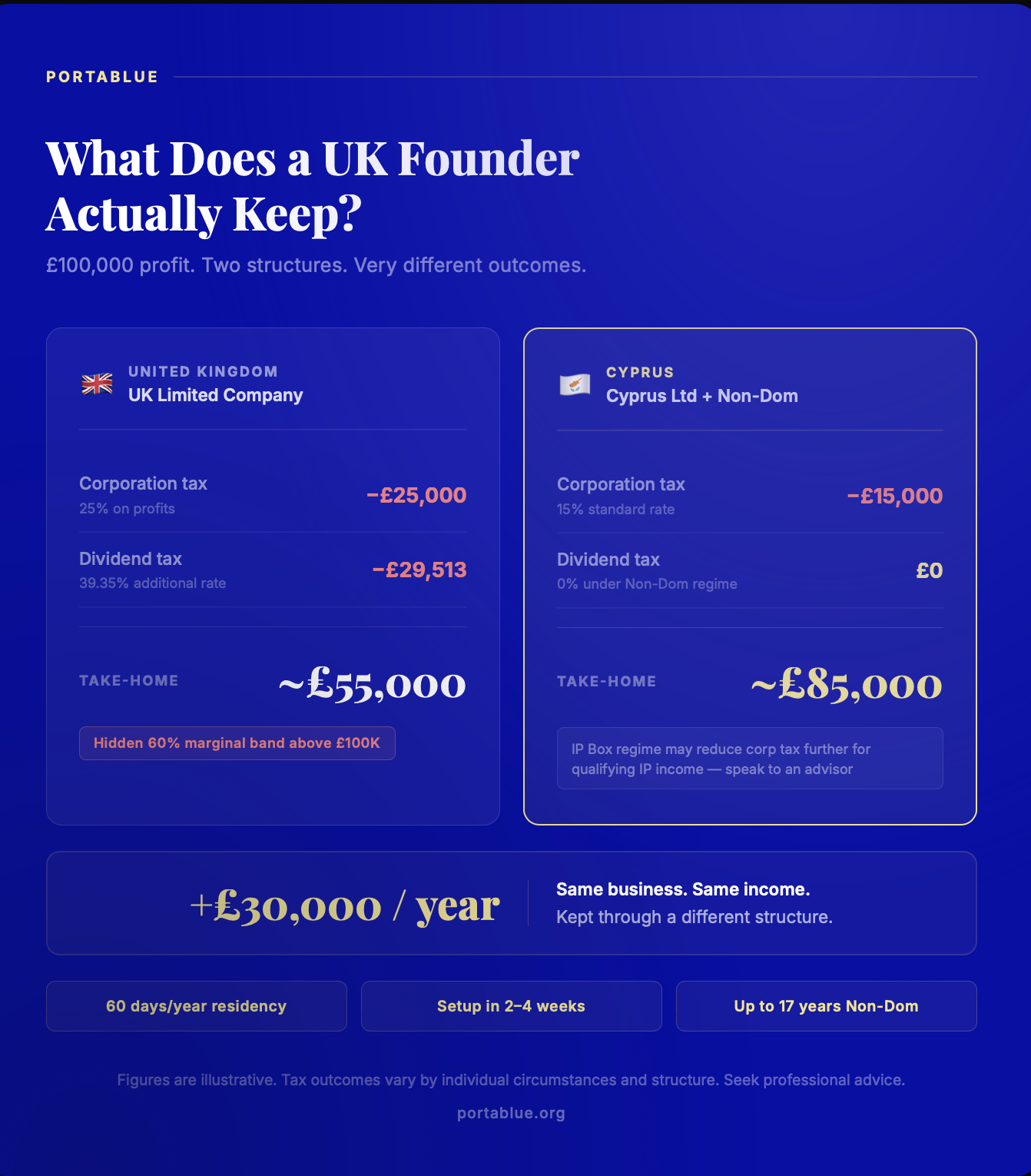
After 25% corporation tax and 39.35% dividend tax on the remainder, the UK founder keeps approximately £55,000.
The Cyprus-structured founder, paying 15% corporate tax with 0% dividend tax under the Non-Dom regime, keeps approximately £85,000.
That's a difference of roughly £30,000 per year. Not a rounding error. Enough to fund a team member, a product sprint, or simply keep in your own pocket.
Tax outcomes depend on your individual circumstances, residency history, and business structure. PortaBlue connects you with trusted Cyprus-based legal and tax professionals to ensure your setup is structured correctly. This article is for informational purposes only and does not constitute tax or legal advice.
The Setup Is Simpler Than You Think
One reason founders put this off is the assumption that moving a business to a new jurisdiction is months of legal complexity. In practice, Cyprus company formation typically takes two to four weeks. Bank account facilitation, tax registration, and the Non-Dom application can run in parallel.
The 60-day presence rule means you are not being asked to abandon your life. Many founders maintain their UK base, spend planned time in Cyprus across the year, and document that presence properly.
Where PortaBlue Comes In
PortaBlue was built for exactly this. We handle the end-to-end Cyprus setup: company formation, bank account facilitation, tax residency guidance, Non-Dom application support, visa assistance where needed, and introductions to co-working spaces and the broader founder community on the island.
We are not lawyers or tax advisors. What we are is a guided path through a process that would otherwise take months of research and coordination across multiple professionals. We connect you with the right local experts, manage the moving parts, and get your structure in place fast.
If you are billing £10,000 a month or more and handing a significant portion of that to HMRC, the financial case for exploring a Cyprus structure is worth taking seriously. The numbers work well above that level too.
Ready to explore Cyprus as your business base? PortaBlue's Early Access Program gives you guided setup, tax support, and ecosystem entry, without the months of research. Apply for early access →